
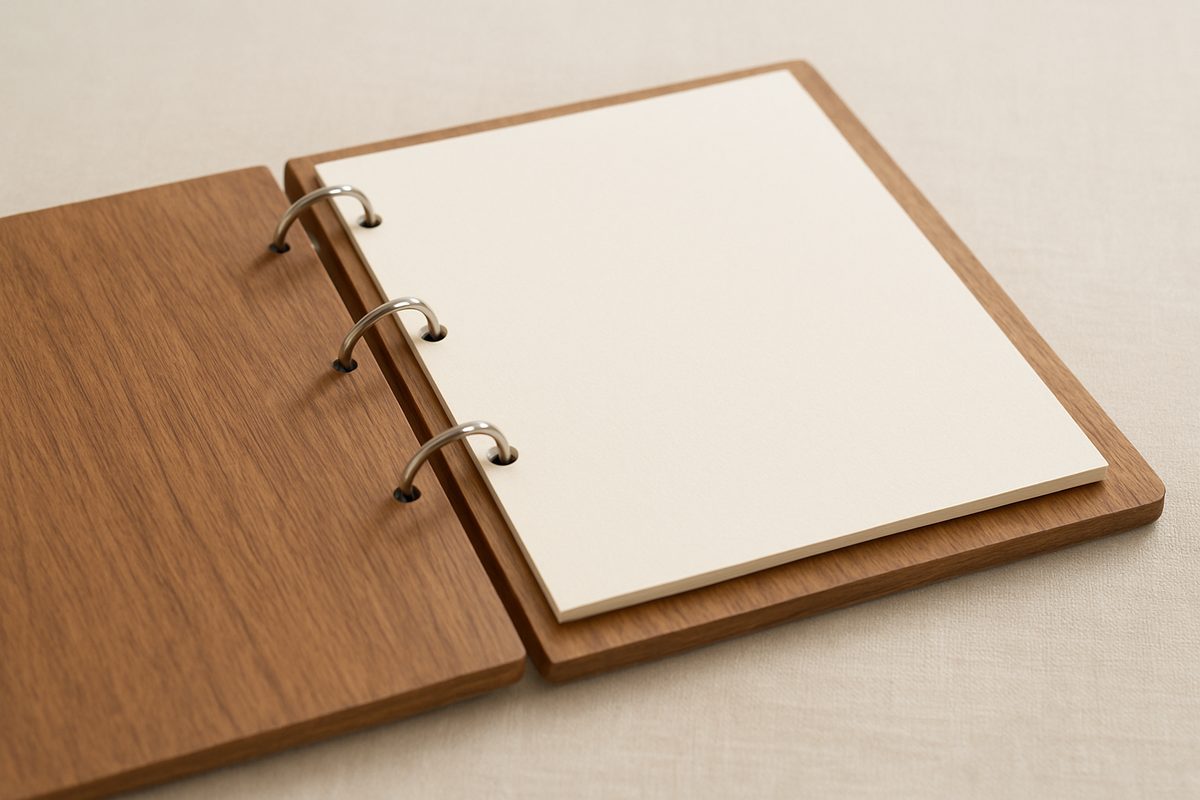
Most printed menus have a short working life. A wine list might change by the glass, a seasonal menu might rotate monthly, and a specials insert might need to be reprinted after a supplier change. When the paper changes faster than the cover, the result is usually a stack of loose sheets, frayed corners, and a table presentation that looks less deliberate than the room around it. Wooden ring binders solve that specific problem by combining a rigid, warm cover with a mechanism that lets staff replace pages in seconds. They are not the right choice for every venue, but for menus that change often they offer a practical middle ground between disposable paper and fully custom case-bound books.
Why Changing Menus Create a Presentation Problem
Most restaurants start with a fixed menu printed in quantity. The unit cost looks attractive until something changes. A dish sells out, a price moves, a wine allocation disappears, or a chef rewrites the dessert section. The usual response is to print a new sheet and slide it into a pocket, staple it, or clip it to the existing menu. Those fixes are functional but rarely elegant. A clear plastic pocket can reflect light and trap crumbs. A staple leaves holes and looks temporary. A bulldog clip adds visual noise. Over time, the menu becomes a collection of corrections rather than a single designed object.
The problem is not the paper. It is the gap between how often the content changes and how often the physical cover changes. A fixed hardcover menu assumes the content is stable. A loose sheet assumes the content is disposable. Wooden ring binders sit between those two positions. The cover stays consistent, and only the pages inside change. That consistency matters because the menu is one of the first printed materials a guest touches after sitting down.

What Wooden Ring Binders Actually Are
A wooden ring binder is a cover made from wood or wood composite, paired with a metal ring mechanism. The rings open and close, so pages with punched holes can be added, removed, or reordered. The most common structure is a two-piece cover with a spine, but some designs use a single board with corner rings. The wood is usually sanded, sealed, and sometimes laser-etched with a logo or border. The ring mechanism may be steel, brass, or a coated metal, chosen to match the cover finish.
The key distinction is mechanical, not decorative. Unlike a perfect-bound or case-bound menu, a ring binder does not require a new cover when content changes. Unlike a screw-post binder, it does not require a driver or a bench to open. Staff can change pages at a side station in less than a minute. That speed is useful when a menu revision arrives during a shift, but the visual benefit is just as important. The cover remains the same object, so the guest sees a consistent material at the table even when the page inside has changed.
The Visual Effect on the Table
Wood changes the way a menu reads before a single word is noticed. A warm wood cover has a low-contrast, matte surface that sits quietly on white table linen or dark wood tables. It does not compete with candlelight the way glossy laminate can, and it does not look disposable the way a plastic cover does. The edge of a wooden menu, especially a thicker board, creates a defined rectangle on the table that helps frame the setting.
That visual weight is useful in rooms where the menu is part of a larger service sequence. A server can place a wooden ring binder flat, open it to the right page, and leave it without the cover curling or sliding. The wood adds enough mass to keep the menu in place, but not so much that it feels bulky. For a guest, the first physical impression is a solid object, not a pile of paper. That impression supports higher menu prices, but only if the condition of the menu is maintained.
Material, Thickness and Finish Choices
Wood selection affects both appearance and long-term performance. Hardwoods such as maple, oak, walnut, and cherry are dense enough to resist dents from daily service. Softer woods can be used, but they show scratches more quickly and may need more frequent refinishing. Wood composite panels are often more stable in humid dining rooms because they move less than solid wood when the air changes. The trade-off is edge appearance. A solid board can be rounded and sanded to show the grain around the perimeter, while a composite edge usually needs a veneer or edge treatment.
Thickness changes the feel of the menu. A thin cover around 3 mm may be light and easy for servers to handle, but it can flex if the menu is large. A thicker board around 6 mm or more feels substantial and protects the pages better, but it adds weight to a stack of menus and may be harder to open flat. The best thickness depends on the table format, the number of pages, and whether the menu is handed to the guest or placed on the table by staff.

The sealant matters more than many operators expect. A matte finish reduces glare and hides fingerprints, while a high-gloss finish can highlight scratches and lamp reflections. An oiled finish feels natural but may need more maintenance. A sealed finish is easier to wipe down, which matters in a dining room where menus come into contact with water rings, butter, and wine. If the cover is laser-etched, the etched area should be sealed as well so it does not trap debris.
Page Sizes and Insert Formats
Wooden ring binders work best when the page size and ring position are planned together. The most common formats follow standard menu sizes such as A4, A5, half-letter, or a long bar menu shape. The pages should be printed with enough margin on the binding edge so the punched holes do not cut through key text or logos. A wider margin on the bound side also makes the page easier to turn without creasing.
When specifying wooden ring binders, the ring diameter is one of the first dimensions to confirm because it sets the maximum number of pages the menu can hold. A small ring may hold only a few sheets, which is fine for a short daily menu. A larger ring can hold more pages, but it raises the profile of the closed menu and may make the cover sit unevenly. The ring spacing should also match the punch pattern on the pages. Most offices have a standard two-hole or four-hole punch, but unusual formats may require custom punching or a different ring count.
Common page formats to consider:
- A5 portrait for compact three-course menus
- A4 portrait for wine lists and large format menus
- Half-letter or digest size for cocktail lists
- Long bar menus with two or three rings set close to the top edge
- Replacement inserts printed on heavier stock to reduce wear around the punch holes
Durability, Cleaning and Daily Care
The weak point of any ring-bound menu is the punched hole. Even a thick cover cannot protect a page if the hole tears. For this reason, the paper stock matters as much as the wood. A heavier uncoated or lightly coated stock holds its shape better than thin paper, and a reinforced strip along the punched edge can add several months of life. If pages are changed often, keep a small supply of pre-punched blanks on hand so a revision does not force staff to punch holes during service.
Wood covers need a simple but consistent care routine. Wipe them with a damp cloth at the end of each shift and dry them before stacking. Avoid soaking the wood or putting wet menus into a closed drawer. Heat and humidity are the main causes of warping. If the venue has an outdoor patio, keep menus inside until they are in use and do not leave them in direct sun for hours. A warped cover will not close cleanly and can strain the ring mechanism.
- Check ring alignment weekly so pages turn without catching.
- Replace torn inserts before the tear reaches the ring.
- Keep covers flat when stored, not standing on edge.
- Use a food-safe wood sealer if the finish begins to look dry.
Cost and Ordering Considerations
Pricing depends on the wood species, cover thickness, ring hardware, and the amount of finishing work. Custom laser engraving or metal corner details add cost, while a simple sanded and sealed cover is more economical. Quantity is another factor because wood covers may be cut and finished in small batches. The page stock is usually a separate line item, so it helps to think of the cover as a long-term investment and the pages as a consumable.
One practical way to control cost is to standardize the page size across menus. If the wine list, bar menu, and dinner menu all use the same punched format, the venue can buy fewer cover sizes and reprint only the sheets that change. Another approach is to order a few extra covers up front. If a cover gets dropped or damaged, having a replacement already finished avoids a visual mismatch caused by a new batch with a slightly different stain.
It is also useful to ask for a sample before committing to a full order. Wood color and grain vary, and a photograph is not the same as feeling the weight in your hand. A sample lets the designer check the edge finish, the ring action, and the way the cover sits on the actual tabletop.
Common Mistakes and a Short Checklist
The most common mistake is treating the wood cover as a decorative shell and ignoring the ring mechanism. A cheap or poorly aligned mechanism will make the menu feel flimsy even if the wood is beautiful. The second mistake is ordering pages that are too thin, which leads to torn holes and loose sheets. The third is choosing a high-gloss finish for a candlelit room, where reflections make the menu harder to read and show every fingerprint.
A working checklist for a venue team:
- Match the ring diameter to the number of pages plus a little extra room.
- Choose a finish that suits the lighting and the amount of handling.
- Confirm the punch pattern before printing a full page run.
- Store covers flat and away from heat.
- Train staff to open and close the rings gently, not by pulling pages.
- Keep the page design simple enough to update without a full redesign.
The value of wooden ring binders shows most clearly over several months of menu changes. A fixed-bound menu starts to look tired after the first revision, while a loose sheet looks temporary from the first service. A wood cover keeps the object stable and lets the pages do the changing. For a venue that updates its menu often, that small difference in structure keeps the printed presentation as deliberate as the food and the room.