
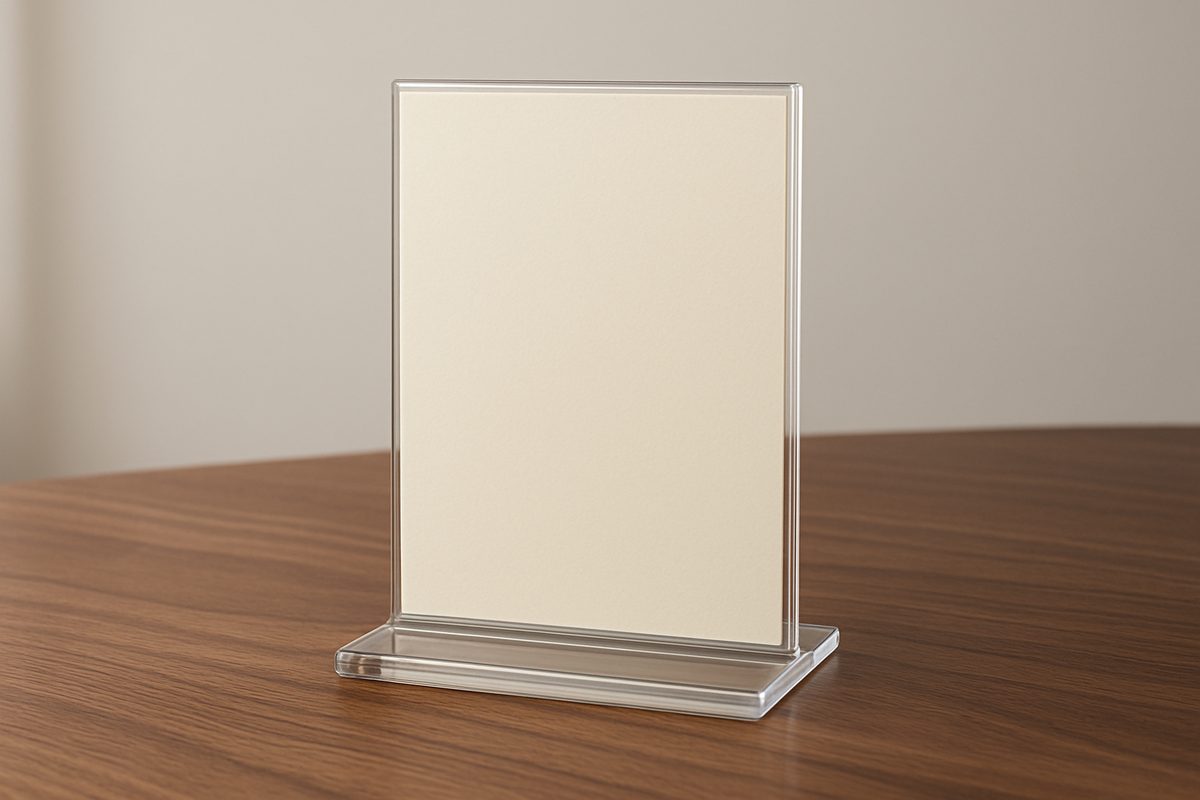
Menu holders do more than prop up a sheet of paper. They set the angle of the printed menu, protect it from spills and handling, and reinforce the visual tone of the room. A holder that is too light falls over. One that is too tall blocks sight lines. One that is scratched or cloudy makes a freshly printed menu look worn before the first dinner order.
Restaurant owners, designers and venue managers tend to spend time on the menu design and less on the object that presents it. That sequence should be reversed. The holder is the first physical boundary between the guest and the print. It is touched, wiped, stacked and moved. It needs to support the paper without competing with it.
The most useful approach is to think of the menu and the holder as one object. Format, material, size, placement and maintenance should be decided together, not treated as separate purchases.
The visual job of a menu holder
A menu holder controls three things at once: angle, stability and edge. The angle determines how much light hits the page. A near-vertical holder can reflect overhead downlights straight into a guest’s eyes. A low angled holder can force the guest to tilt their head. The most comfortable reading angle for a tabletop insert is usually between 15 and 45 degrees from vertical, but the exact position depends on chair height, table height and the distance between the guest and the menu.
Stability matters more than it seems. A lightweight holder with a narrow base can slide when a guest picks up a menu or brushes the table. If the holder tips every time a server places a coffee cup, the resulting noise and movement become part of the room’s background stress. Heavier bases, wider footprints and non-slip pads help keep the menu where it belongs.
Edges are the small detail guests notice without naming. A sharp acrylic corner can feel cheap. A rolled metal edge can catch the light. A leather wrapped rim can add warmth. The holder should frame the menu but never draw attention away from it. A simple rule for most dining rooms is to keep the holder visually quieter than the menu cover or the printed insert.

Formats that fit different service points
Menu holders fall into a few practical families. Choosing the right family usually comes down to where the menu lives and how often the insert changes.
Tabletop upright holders
The classic upright holder is a clear or framed piece that holds one or two sheets at a slight backward tilt. It works well for tables of two to six, breakfast menus, wine lists and dessert cards. Because it sits in the guest’s direct line of sight, it should be low enough to see over. A common mistake is buying a tall holder for a small table, which blocks conversation and makes the table feel crowded.
Clear acrylic versions are the workhorse. They are easy to wipe, inexpensive to replace, and visually neutral. Black, white and wood grain frames create a stronger boundary around the insert and can match the room’s trim or chair legs. For elevated dining rooms, leather or wood frames with a low profile often read as more intentional.
Flat table tents and countertop sleeves
Flat table tents hold a folded sheet or two rigid panels and are ideal for bar counters, cafe tables and specials. They can be read from both sides when placed in the middle of a table. The main risk is that they take up more of the visible table surface. In a small space, a tent with a narrow footprint works better than a wide V-shaped stand.
Countertop sleeves are simpler. They are usually a clear plastic pocket with a sealed edge, placed near the POS or host stand. They suit printed inserts that change daily, such as a revised menu, a notice or a drinks card. Because they lie flatter, they are harder to read from a distance. They should be placed where guests are already standing or waiting.
Wall mounted and swinging holders
Wall mounted holders keep menus off the table entirely. They are common outside doors, near host podiums and in narrow service areas. A wall mount can hold a single page, a padded cover or a set of sheets. The screw holes, standoffs and backplates are part of the visual result, so the finish should match other wall fixtures such as coat hooks, light switches and handrails.
Swinging holders with a hinge allow the menu to be read while it stays attached to a post or rail. They reduce the number of loose items staff have to reset. The trade-off is that one guest can monopolize the menu while others wait. For that reason swinging holders tend to work better at a host stand or a waiting area than at every table.
Freestanding A-frames and large display stands
Freestanding A-frames and heavy floor stands work for sidewalk menus, entrance boards and large format printed sheets. They are usually made from wood, metal or a combination. They need enough weight to resist wind outside and enough style to meet the standard of the interior. When used indoors, an A-frame should be placed out of the main walking path and away from doors that swing open.
Materials, texture and daily wear
The material of a menu holder changes how it feels, how it cleans, and how long it looks new. It also sets a price band. In general, clear and molded plastics sit at the lower end of the range, metal and wood sit in the middle, and solid hardwood, stone or custom leather can move toward the upper end. This is not a fixed scale, because thickness, finish and quantity affect the final price.
Acrylic and PET plastic
Acrylic is clear, light and easy to replace. It is common in high traffic settings because it can be wiped quickly and does not rust. The downside is that acrylic scratches over time. Hairline marks from stacking, cleaning cloths and keys can turn a clear holder cloudy. Look for thicker edges and polished seams. Avoid using abrasive pads or strong solvents on acrylic, because they speed up the loss of clarity.
PET plastic is lighter and often used in folded sleeves. It is a good choice for short term inserts and fast changing menus. It is less rigid than acrylic and may curl at the edges if exposed to heat. Keep PET holders away from direct sunlight and heat lamps.
Wood and wood grain frames
Wood holders add warmth and quiet contrast to a printed menu. They suit rooms with natural tabletops, leather seating or warm lighting. Solid wood can be oiled, waxed or lacquered. Lacquered finishes are easier to wipe down in a busy dining room. Oiled finishes require more care but can be lightly restored when they show wear. Watch for splits at the joints if the holder is moved and stacked often.
Metal, brass and powder coated finishes
Metal holders vary from thin wire stands to heavy machined bases. Black powder coated steel is common in industrial and modern rooms. Brass and copper finishes add a softer metallic note and work well in bars and older buildings. The main practical concern is whether the metal edge scratches the table or the printed insert. A holder with a rough seam or an exposed screw head will damage both. Rounded edges, soft feet and flush fittings keep the holder safe to handle.
A menu holders overview can help you compare these material options before ordering samples.

Insert size and paper compatibility
Menu holders and printed inserts need to be specified together. A holder that accepts a 4 by 6 inch card will not fit an A5 sheet without trimming. Standard paper sizes are not universal across every print shop, so always confirm whether the menu is designed for US letter, A4, A5, DL or a custom cut. The holder’s listed size should refer to the visible insert area, not the outer frame.
Paper weight changes how a holder works. A flimsy 20 lb sheet can sag in a tall holder. A heavy cover stock can make a narrow slot difficult to load. For most tabletop upright holders, an insert between 80 lb text and 100 lb cover feels substantial enough to stay flat without bulging. If the menu is printed on textured cotton paper, the holder’s clear front should not press too tightly against the surface. Too much pressure can create a glossy patch or transfer indentations.
Double sided menus need a holder that allows the guest to flip the sheet or see through both sides. Clear acrylic pockets work well for this. Opaque holders are better for single sided prints. If the menu is changed daily, choose a top loading or open side design that staff can update without removing the holder from the table.
Always test the full insert stack, not just one sheet. A holder that looks clean with one page may bow with six pages. The spine or pocket should allow the menu to close flat. If the holder grips too tightly, the first and last pages will curl.
Placement, sight lines and lighting
Where a menu holder sits is as important as what it looks like. At a dining table, the holder should sit to the side of the place setting, not directly in front of the guest. A centered holder blocks the space where a plate will arrive. It also forces each guest to look down at the same point, which can feel crowded in a group.
Sight lines matter in a room with low chairs or booths. Tall holders can hide a guest from a server. If the room has an open kitchen or a view, a high holder may block the sight line that makes the table feel special. Low profile holders are safer for small tables. Wall mounted holders can be placed at eye height near the entrance, but they should not force a guest to stand in the walking path to read.
Lighting is another practical factor. Overhead spots, pendant lamps and window light create glare on clear acrylic. A slight backward tilt can reduce reflections. A matte or etched acrylic panel can diffuse the light, but it also reduces the sharpness of the printed text behind it. If the menu text is small, keep the front panel clear and adjust the angle instead. If the room is bright with hard downlights, a wood or metal holder with no glossy front may be easier to read.
Cleaning, storage and replacement cycles
Menu holders collect fingerprints, crumbs and condensation. The cleaning routine should match the material. Clear plastic needs a soft cloth and mild soap. Disinfectants are often used on tables, but repeated alcohol based sprays can cloud acrylic. Check with the supplier for the correct cleaning agent. A holder that sits on a bar top near a draft beer tap will need more frequent wiping than one used only at dinner.
Wood holders should be wiped with a damp cloth and dried. Do not soak them in dishwater. Metal holders can rust at the joints if water sits in a seam. Stainless steel and aluminum are less likely to rust, while unsealed iron will mark. Any holder with a pad or felt base should have that base checked after a deep clean. Pads peel when they stay wet.
Replacement cycles depend on volume. A busy counter may need to swap a few scratched holders every quarter. A fine dining room with low volume may go years before the expense. The test is visual. Hold the holder at arm’s length under dining room light. If the scratches, clouding or bent corners are visible before the menu, it is time to replace the holder. Keeping a small reserve stock prevents mismatched styles when one holder breaks.
Common mistakes and a practical checklist
Most holder mistakes come from buying before measuring. The result is a mix of formats that do not match the menu size, the table surface or the service style. Here is a short checklist for selecting and maintaining holders.
- Measure the printed insert before ordering. Confirm the listed dimensions are for the visible area, not the outer frame.
- Set a maximum holder height for each table size. At a two top, the holder should sit below eye level and out of the plate path.
- Match the holder material to the cleaning routine. Avoid bare steel or unfinished wood in wet areas.
- Order one or two samples first and test them with the real insert, the real table and the real lighting.
- Check the feet or base pad for scratches before buying. A metal edge that touches the table should be smooth or padded.
- Store spare inserts and spare holders together. A missing menu can often be refilled faster when formats are standardized.
- Inspect every holder weekly for clouded fronts, loose joints, rust marks and bent corners.
The holder should make the printed menu easier to read, not harder. When the format, material and placement are aligned, guests notice the menu first and the room feels more composed. That is the result a well specified holder earns every service.